When the kitchen stops,
everything stops
Commercial refrigeration, walk-in coolers and freezers, ice machines, ovens, pizza ovens, fryers, dishwashers and exhaust hoods — repaired across South Florida. A technician on site within 2 hours when your equipment is down, nights and weekends included.
The four-hour clock
Product held above 41°F for more than four hours has to be thrown out.
That is the Florida food code standard, and it is why a walk-in failure is not a maintenance ticket — it is a countdown. A single failed box routinely puts several thousand dollars of inventory at risk before anyone opens for service.
Call it in the moment the temperature starts climbing, not after it has been warm all night.
Call (888) 822-7754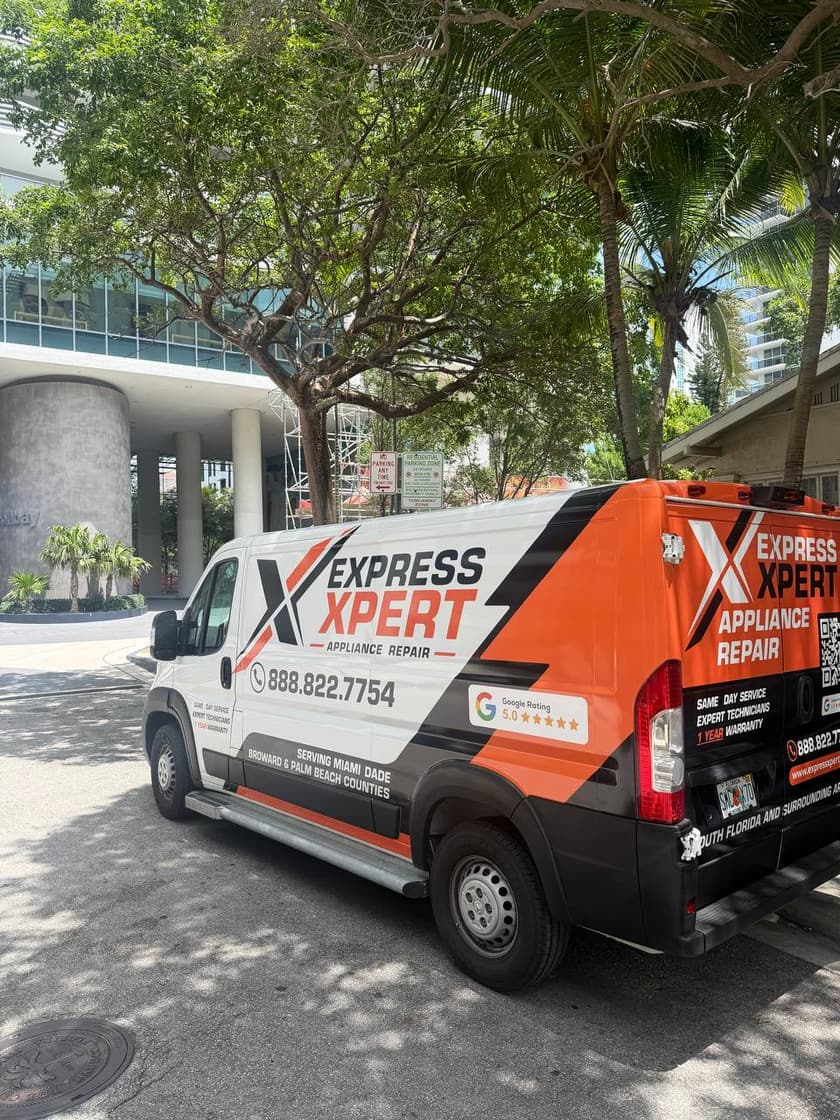
You will know exactly who is pulling up
Marked vehicle, company name and phone number down the side. On a commercial job that is not vanity — it is how your technician gets past a security desk at a Brickell tower, into a hotel loading dock, or through a service entrance without somebody having to come down and vouch for him.
It also arrives loaded. The complaint operators make most about repair companies is the diagnostic visit that ends with a part on order and a kitchen still down three days later, so we ask for the make and model on the phone and put the likely failures on the truck before we roll — fan motors, contactors, thermostats, gasket stock, igniter components, control boards.
Serving Miami-Dade, Broward and Palm Beach counties · 5.0★ on Google
Everyone says “licensed and insured”. Here are the actual numbers.
Search commercial kitchen repair in Miami and you will read the same badge on every site. Almost nobody prints a certificate number, an insurance limit, or a response time you could hold them to. These are ours.
What the 2-hour response actually means
It applies when commercial equipment is down — a walk-in losing temperature, an ice machine dead before service, a cookline unit that has stopped. It is a technician on site, not a callback. Scheduled work and estimates are booked into a window that suits your service hours instead, because you do not want us arriving mid-dinner for a maintenance visit.
Tell the dispatcher it is an emergency when you call. That is the word that moves you into the 2-hour queue.
The whole kitchen, one number
Most kitchens run three vendors — one for refrigeration, one for the cooking line, one for warewashing — and chase three invoices for what was one bad night. We cover all of it.
Commercial Refrigeration
Reach-ins, prep tables, display cases & bar coolers
- Reach-in holding above 41°F
- Compressor running nonstop
- Ice buildup on the evaporator
Walk-In Coolers & Freezers
Box down, doors, coils, compressors & controls
- Box climbing above 41°F
- Freezer not holding 0°F
- Condenser iced over
Commercial Ice Machines
Cubers, flakers, nugget & remote condenser units
- Making little or no ice
- Hollow or soft cubes
- Machine cycling but not harvesting
Commercial Ovens & Ranges
Convection, combi, deck ovens & the cooking line
- Oven not holding temperature
- Uneven bake across the deck
- Igniter clicking, no flame
Pizza Ovens
Deck, conveyor & brick oven repair
- Deck not reaching temperature
- Conveyor belt stalling or dragging
- Uneven bake front to back
Commercial Dishwashers
High-temp, low-temp & conveyor warewashing
- Not reaching sanitizing temperature
- Standing water / not draining
- Wash arms not spinning
Exhaust & Range Hoods
Fans, motors, dampers & makeup air — repair, not cleaning
- Fan not pulling smoke
- Motor humming or seized
- Belt slipping or snapped
Fryers, Griddles & Steamers
The rest of the hot line
- Fryer not holding oil temperature
- High-limit tripping repeatedly
- Griddle heating unevenly
Brands we see most: True, Turbo Air, Traulsen, Beverage-Air, Continental, Master-Bilt, Kolpak, Nor-Lake, Bally, Heatcraft, Copeland, Hoshizaki, Manitowoc, Scotsman, Ice-O-Matic, Follett, Vulcan, Garland, Blodgett, Rational, Southbend, Montague, Middleby Marshall, Baker’s Pride, XLT, Lincoln, Marsal, Hobart, Champion, Jackson, CMA, Ecolab, CaptiveAire, Greenheck, Accurex, Halton, Frymaster, Pitco, Henny Penny, Cleveland.
Equipment down right now? Tell the dispatcher what is down and how long it has been warm — that decides what we do first.
Call (888) 822-7754Your walk-in is climbing and you open in three hours
Do these while you wait for a technician. None of it fixes the box, but it decides how much product you still have when we get there.
- 1
Get a thermometer in the product, not the air
Air temperature swings every time the door opens. What matters for the food code is the internal temperature of the product itself. Cold-holding is 41°F or below — that is the number an inspector checks, and the number that starts the four-hour clock.
- 2
Start moving the most valuable product first
Proteins and dairy before produce. If you have a second box, a reach-in, or a neighbouring restaurant that owes you a favour, use it now rather than in an hour. Product moved before it warms is product you still get to sell.
- 3
Keep the door shut and write down the time
Every open dumps the remaining cold. Note the time the temperature first went out of range — if you end up in a health-inspection or insurance conversation later, that timestamp is the whole argument.
- 4
Check the obvious before you pay for a diagnostic
Breaker tripped, thermostat knocked off setting, condenser packed with grease and dust, a door that has not been sealing since someone backed a hand truck into it. We would rather tell you it was a breaker on the phone than charge you to come flip one.
- 5
Call and describe the failure, not the equipment
"Walk-in at 52°F since last night, fans running, compressor not kicking on" tells a dispatcher what parts to load. "Cooler is broken" does not. The better the description, the better the odds we fix it on the first visit instead of ordering a part and coming back.
A residential company moving into commercial — and saying so
Express Xpert has repaired appliances in South Florida homes since 2018, and earned a 5.0 rating across more than 400 Google reviews doing it. Commercial kitchens are the newer side of the business. We would rather tell you that than invent a decade of restaurant history — you will find out either way the first time a technician opens a panel.
What carries over is the part most kitchens complain about: dispatch that calls back, technicians who show up in the window, a written number before the work starts, and someone who tells you when a repair is not worth it. Ask us for references on commercial jobs and we will give you what we have, not a page of logos.
Parts on the truck, not a promise and a return trip
The complaint operators make most about repair companies is not the price — it is the diagnostic visit that ends with a part on order and a kitchen still down three days later. We load the common failures for your equipment before we roll: fan motors, contactors, thermostats, gasket stock, igniter components, control boards.
Two hours, and we mean on site
A walk-in above 41°F has a four-hour clock on the product inside it. A 2-hour response is inside the window where the load is still saveable — which is the entire point of promising a number instead of saying "as soon as we can". Nobody else in this market publishes one.
We tell you when it is still under warranty
If your equipment is in warranty and the manufacturer should be covering the repair, we will say so — even though that means we do not get the job. We would rather be the company you call for the next ten years than bill you once for something the OEM owed you.
A real dispatcher, not a national queue
Chains routed through national facilities platforms regularly get a cooler fault dispatched to an electrician. You are describing your failure to a person who decides what parts go on the truck, and who calls you back.
We schedule around service, not through it
We ask when your kitchen is dark before we book — the afternoon lull, a Monday closure, before open. A technician who arrives mid-dinner-service costs you more than the repair does. Equipment that is fully down is the exception; that gets attention immediately.
Paperwork ready before you ask
Certificate of insurance and W-9 on request, so procurement at a hotel or restaurant group is not the thing holding up your repair. A broker typically takes three to five business days to issue a fresh COI — that wait should not be yours.
Kitchens that cannot afford a dark day
Florida’s regulator lists 9,331 licensed food service establishments in Miami-Dade County alone, plus 605 hotels and motels. Nearly all of them run refrigeration, ice and a cooking line that has to work every single day.
Restaurants
Independent kitchens, chains and franchise locations.
Hotels & Resorts
Banquet kitchens, on-premises laundry, in-room and lobby equipment.
Bars & Nightclubs
Ice, back-bar coolers, keg boxes and glasswashers.
Cafés & Bakeries
Deck ovens, proofers, display cases and brewers.
Pizzerias
Deck and conveyor ovens, dough coolers, prep tables.
Grocery & Bodegas
Display cases, walk-ins and beverage coolers.
Ghost Kitchens & Commissaries
Equipment-dense, shared, running near-continuously — and nobody in Miami targets them.
Schools & Care Facilities
Cafeteria lines, assisted living and healthcare food service.
Know the number before we start
Written quote on site, approved by you, before any work begins — the same way we have done residential since 2018.
We fix what the inspector wrote you up for
Florida’s Division of Hotels and Restaurants inspects licensed establishments two to four times a year, unannounced. Temperature-control failures fall in the highest-risk violation tier — the category tied directly to foodborne illness. Most of them trace back to equipment, not to anything your staff did wrong.
| What gets written up | The equipment behind it |
|---|---|
| Cold food held above 41°F | Walk-in or reach-in losing temperature — failing compressor, iced evaporator, torn door gasket, condenser choked with grease. |
| Hot food held below 135°F | Holding cabinet, steam table or warmer with a drifting thermostat or dead element. |
| Dish machine not sanitizing | Booster heater not reaching final rinse temperature, or a chemical dispenser that stopped drawing sanitizer. |
| Worn or torn door gaskets | A cheap part that fails the inspection and quietly runs your compressor to death at the same time. |
| Inaccurate or missing thermometers | Often flagged alongside a box that genuinely is not holding — worth confirming which one is actually wrong. |
| Ice machine build-up | Scale and slime in the bin and evaporator; needs cleaning and often a water filter that is long overdue. |
Got a report in hand with a callback date on it? Read us the violations over the phone — we will tell you which ones are equipment repairs and which are procedural, so you are not paying a technician to solve a paperwork problem. Florida’s inspection records are public at MyFloridaLicense.
Nobody in this market publishes prices. Here is the range anyway.
Search commercial kitchen repair in Miami and almost every company will tell you to call for pricing. That is not much use at 6am with a warm box. These are published national industry ranges, so you can at least tell whether a quote you are holding is sane.
| Item | Published industry range |
|---|---|
| Diagnostic / trip fee | $85 – $175 |
| Standard labor | $75 – $150 per hour |
| After-hours surcharge | $100 – $300 |
| Common repairs (thermostats, fans, valves, gaskets) | $150 – $600 |
| Major components (control boards, compressors) | $400 – $1,200+ |
| Walk-in compressor replacement | $2,000 – $4,500 |
| Refrigerant | $15 – $100 per lb |
These are national industry ranges published by trade and cost-guide sources, shown so you can sanity-check any quote you receive. They are not Express Xpert prices — we quote your specific equipment on site, in writing, before any work begins.
The cheapest repair is the one booked on a Tuesday
Industry guidance is twice-yearly service on commercial refrigeration as a baseline, quarterly for high-volume kitchens, grocery and healthcare food service, and more often once equipment passes seven or eight years old. In South Florida there is a second reason: condensers here fight ambient heat most of the year, and a coil packed with grease and dust is the single most common thing standing between a working box and a failed one.
Condenser coils, quarterly at minimum
Kitchen air is greasy air. Grease traps dust, dust blankets the coil, and the compressor runs hot and long until it does not run at all. This is the highest-value 20 minutes anyone spends on your equipment.
Door gaskets, every visit
A torn gasket is a cheap part that fails an inspection and runs your compressor to death at the same time. Check them by closing the door on a dollar bill — if it slides out freely, the seal is gone.
Ice machine cleaning and filters
Scale and slime build in the evaporator and bin. Left alone it becomes a health finding and an ice shortage on your busiest night. Filters have a service life; most kitchens are well past it.
Hood motors, belts and makeup air
A hood that is not pulling is a fire-code and comfort problem before it is a repair. Belts stretch, bearings dry out, and the first symptom is usually a kitchen nobody wants to work in.
Get us on file before you need us
Almost nobody changes repair companies while things are working. They change at 6am with a warm walk-in, when the usual guy is not picking up — and then they are choosing a stranger from search results under maximum pressure.
Call us now, while nothing is broken. We will take your equipment list, send the insurance certificate and W-9 so your paperwork is already done, and put you in the system. It costs nothing and it is not a contract. When something does go down, you are calling a company that already knows what you run.
Maintenance, in plain arithmetic
The number quoted across the trade is a planned maintenance programme at roughly $4,000 a year against up to $8,000 for a single critical failure once you add overtime, expedited parts and thrown-out product. Published estimates put the reduction in repair spend at 10–18%, with up to 20% off energy use from clean coils and sealing doors.
It does not pencil out for every kitchen. It pencils out hard where one machine defines the concept — the deck oven in a pizzeria, the fryer in a chicken shop, the walk-in in a high-volume kitchen. Tell us what you run and we will tell you honestly whether a schedule is worth it for you.
Figures above are published industry estimates, shown for comparison — not an Express Xpert quote.
Commercial coverage across South Florida
Miami-Dade, Broward and Palm Beach — 19,137 licensed food service establishments between them, according to Florida’s own licensing records. These are the Miami-Dade corridors where the kitchens are densest.
Downtown & Brickell
Hotel, corporate dining and high-rise restaurant density.
Miami Beach & South Beach
The county’s heaviest hotel, resort and nightclub concentration.
Wynwood & Design District
Dense independent restaurant, bar and brewery cluster.
Little Havana & Hialeah
Independent kitchens, bodegas and cafés — largely Spanish-speaking ownership.
Coral Gables & Coconut Grove
High-end dining rooms and country clubs.
Doral & Miami Springs
Airport hospitality and catering corridor, corporate campuses.
Kendall & South Miami
Restaurant corridors, schools and chain locations.
Aventura & North Miami
Mall food service, hotels and clubs.
Get a commercial technician dispatched
Tell us what is down and how fast you need it. Commercial requests go to a dispatcher, not a general queue — and we ask for your service hours so a technician is not arriving in the middle of your dinner rush.
- Technician on site within 2 hours when equipment is down
- Written quote before any work begins
- $5M general liability — COI and W-9 for vendor onboarding
- Net-30 terms available for registered businesses
Equipment down right now? Calling is faster — (888) 822-7754.
Commercial kitchen repair — FAQ
How fast can you get to a restaurant with a walk-in cooler down?
A technician on site within 2 hours when commercial equipment is down. That matters because product held above 41°F for four hours has to be discarded under the Florida food code — a 2-hour response is inside the window where the load is still saveable. Say the word emergency when you call so the dispatcher puts you in that queue, and start moving your highest-value product anyway while we are on the way.
What commercial kitchen equipment do you repair?
Commercial refrigeration (reach-ins, prep tables, display cases, bar and beverage coolers), walk-in coolers and freezers, ice machines, commercial ovens and ranges, pizza ovens including deck and conveyor, fryers, griddles and steamers, commercial dishwashers and warewashing, exhaust and range hood systems, and on-premises laundry equipment for hotels and laundromats.
Do you work around service hours?
Yes, and we ask about them on the first call. A technician who shows up at 7pm on a Friday to pull a compressor is a problem, not a solution. Tell us when your kitchen is dark — the afternoon lull between lunch and dinner, a Monday closure, before open — and we will schedule into it wherever the failure allows. Equipment that is fully down and losing product is the exception; that gets attention immediately.
How much does commercial kitchen equipment repair cost?
We quote your specific equipment in writing, on site, before any work begins. For reference, published national industry ranges put diagnostic fees around $85 to $175, labor at roughly $75 to $150 per hour, and after-hours surcharges from $100 to $300, with common repairs landing between $150 and $600 and major component work such as compressors and control boards running $400 to $1,200 or more. Those are industry figures published by trade sources, shown so you can sanity-check any quote you receive — they are not our price list.
Can you provide a certificate of insurance and a W-9?
Yes. We carry $5 million in general liability and can issue a certificate naming your business as additional insured, along with a W-9. Most hotel and restaurant-group vendor policies ask for $1 million per occurrence and $2 million aggregate, so our limit clears that comfortably. Ask for the packet when you call so procurement is not the thing holding up your repair.
Do you offer payment terms?
Net-30 terms are available for registered businesses. If you are a registered company with an accounts payable process, we can invoice rather than taking payment on completion — tell us when you set the account up and we will get the paperwork in place before the first job rather than in the middle of one.
Are your technicians certified to work on refrigerant systems?
Yes. Refrigerant work is handled under EPA Clean Air Act Section 608 certification — Ramil Askarov holds Universal certification, certificate number ECN20261136. Universal is the full-scope credential covering Type I, II and III equipment, which includes the high-pressure systems in walk-in coolers, freezers and ice machines. Federal law requires it for anyone opening a sealed refrigeration system, and we can provide a copy of the certificate on request.
Do you handle gas-fired equipment?
Gas equipment is split work in Florida. Repairs to the appliance itself — thermostats, controls, blowers, conveyor drives, igniter components, hood motors — are ours. Work on the gas supply line falls under separate Florida licensing (a gas contractor licence for natural gas, an FDACS LP Gas Installer licence for propane), and we will tell you plainly when a job needs that licensed trade rather than taking it on ourselves.
Do you offer preventive maintenance for commercial kitchens?
Yes. Industry guidance is twice-yearly service on commercial refrigeration as a baseline, moving to quarterly for high-volume kitchens, grocery and healthcare food service, and more often for equipment past seven or eight years old. Scheduled maintenance is what turns a Friday-night emergency into a Tuesday-afternoon visit. Call and we will build a schedule around your equipment list.
Do you serve businesses outside Miami-Dade?
Yes — Miami-Dade, Broward and Palm Beach counties. Within Miami-Dade our heaviest commercial coverage runs through Downtown and Brickell, Miami Beach, Wynwood and the Design District, Little Havana and Hialeah, Coral Gables, Doral and the airport corridor, and the Kendall and South Miami corridor.
Equipment down? Call before the product does.
(888) 822-7754 — commercial dispatch for Miami-Dade, Broward and Palm Beach. English and Spanish.